A Texas worker can earn a good salary and still be unsure about one simple question: how much of that pay is he or she allowed to put into a 401(k) this year? The answer changes almost every year, and for 2026 the IRS raised the main limit again.
This guide sets out the 401(k) contribution limits for 2026 in plain words: the exact figures by age, a brand-new Roth rule that starts in 2026, and — something most guides skip — what the maximum looks like on a real Texas paycheck, where there is no state income tax at all.
The figures come from the IRS announcement for 2026, Notice 2025-67. This is general information, not personal financial or tax advice.
Key Takeaways
- The employee limit for 2026 is $24,500 for a worker under 50, up from $23,500 in 2025.
- A worker aged 50 or over can add an $8,000 catch-up, for a total of $32,500. A worker aged 60, 61, 62 or 63 can add $11,250 instead, for a total of $35,750.
- Employee and employer money together cannot pass $72,000 in 2026, or 100% of the worker’s pay, whichever is less.
- Starting in 2026, a high earner whose 2025 wages passed $150,000 must make catch-up contributions into a Roth 401(k), not a traditional one.
- A 401(k) runs on payroll dates, so the last day to contribute for 2026 is December 31, 2026 — not the April tax deadline that applies to an IRA.
401(k) Contribution Limits for 2026 at a Glance
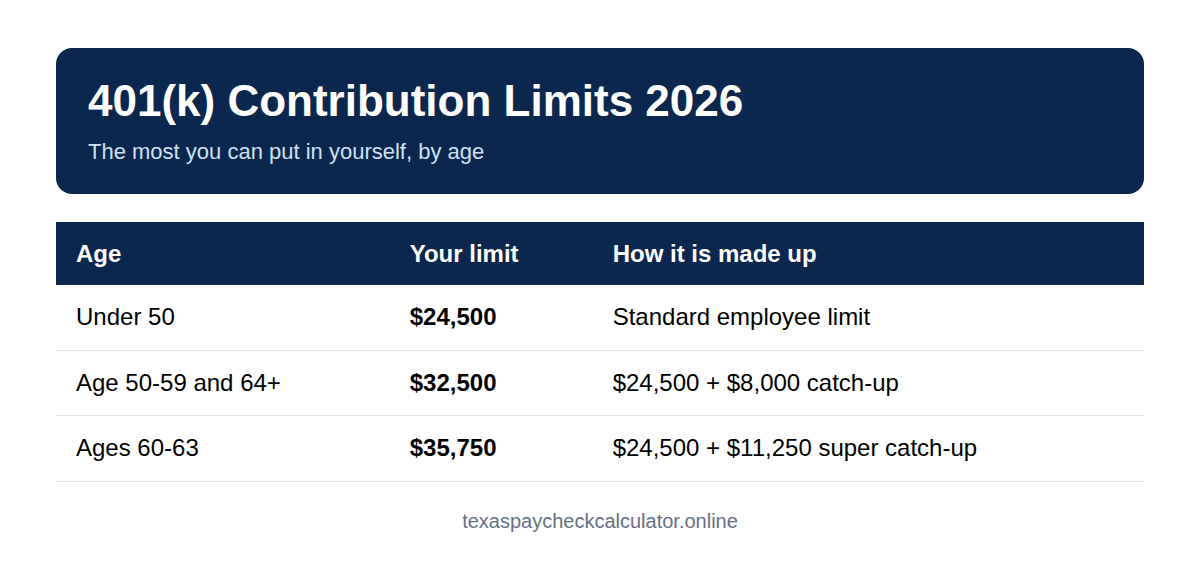
| Age at the end of 2026 | Normal limit | Catch-up amount | Most the worker can put in |
|---|---|---|---|
| Under 50 | $24,500 | None | $24,500 |
| 50 to 59, and 64 or over | $24,500 | $8,000 | $32,500 |
| 60, 61, 62 or 63 | $24,500 | $11,250 | $35,750 |
Three points in this table catch people out. First, the limit belongs to the person, not to the job or the plan: a worker with two 401(k) plans does not get two limits, and all contributions across plans must stay within the one figure above. Second, the catch-up sits on top of the normal limit, not inside it — $24,500 plus $8,000 is $32,500, and $24,500 plus $11,250 is $35,750. Third, traditional and Roth money share the same limit: $15,000 pre-tax plus $9,500 as Roth money already reaches the $24,500 cap.
2026 vs 2025: What Changed
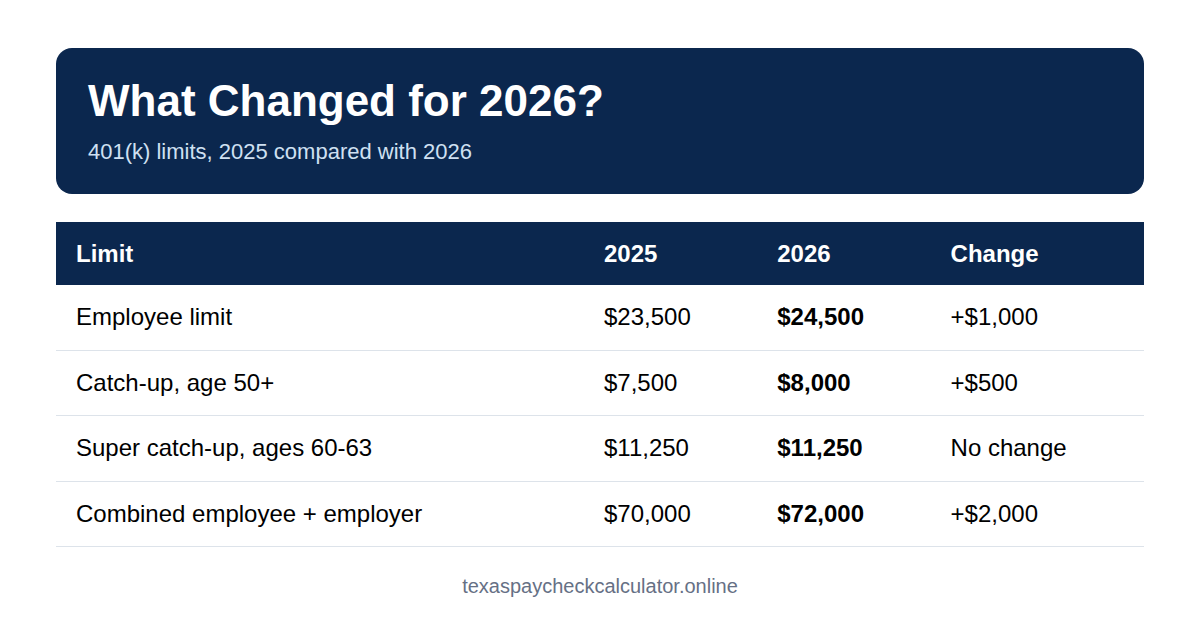
| Limit | 2025 | 2026 | Change |
|---|---|---|---|
| Employee contribution limit | $23,500 | $24,500 | +$1,000 |
| Catch-up, age 50 and over | $7,500 | $8,000 | +$500 |
| Super catch-up, ages 60 to 63 | $11,250 | $11,250 | No change |
| Combined employee and employer limit | $70,000 | $72,000 | +$2,000 |
| Annual compensation cap | $350,000 | $360,000 | +$10,000 |
The full official announcement is the IRS newsroom release, 401(k) limit increases to $24,500 for 2026, published with Notice 2025-67.
Why the IRS Raises the Limits
The limits are linked to the cost of living. Each fall, the IRS looks at inflation and adjusts the figures, rounding to the nearest $500 — hence the neat $1,000 rise in the employee limit and $500 rise in the standard catch-up for 2026. In a low-inflation year a limit can instead stay exactly where it was, as the super catch-up has done, which is why a worker who set a percentage once and never looked again can drift away from the maximum. A short check each January is worthwhile.
Catch-Up Contributions at 50 and Over
A catch-up contribution is an extra amount the law allows an older worker to put in, on top of the normal limit, to help make up for years when saving was harder.
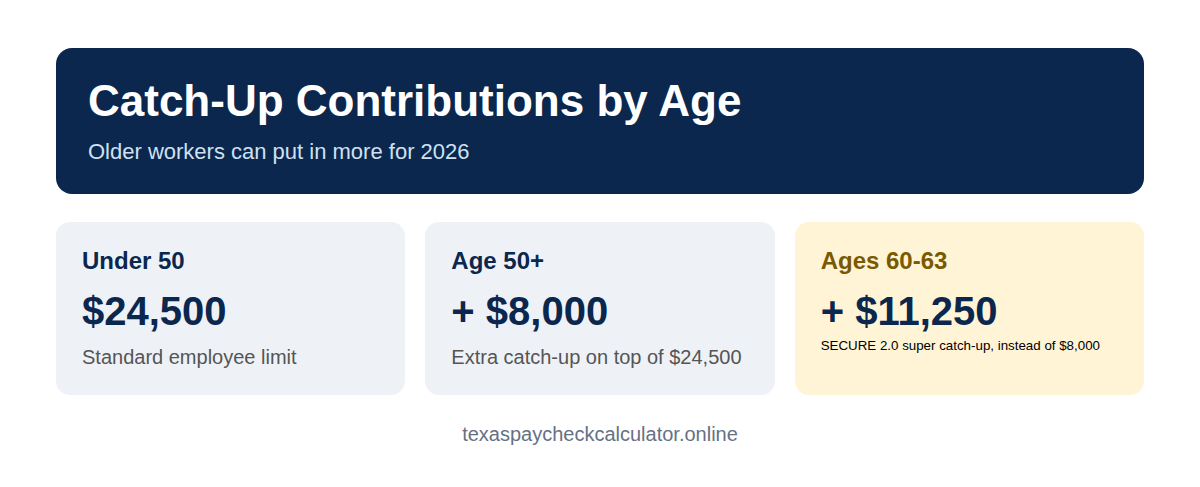
For 2026, the standard catch-up is $8,000, open to any worker who reaches age 50 by December 31, 2026 — even a worker who turns 50 on the last day of December qualifies for the full amount for that year. The full employee total at 50 to 59, or 64 or over, is therefore $32,500, and the catch-up alone is $307.69 on each biweekly paycheck: a real part of a late-career saving plan, not a token extra.
Two practical points matter. First, the plan has to allow catch-up contributions — most large plans do, but it is part of the plan document, not an automatic right. Second, the money must move through payroll before the year ends.
The Super Catch-Up for Ages 60 to 63
Since 2025, under the SECURE 2.0 law, workers aged 60, 61, 62 or 63 have had a higher catch-up limit than everyone else: $11,250 for 2026, the same as in 2025.
The key point is that it replaces the standard catch-up; it does not stack on top of it. A 62-year-old does not get $8,000 plus $11,250, but $11,250 in place of the $8,000 — $3,250 more — for a full employee total of $35,750.
As with the standard catch-up, the plan must offer the higher amount, so a worker in this group should confirm it is switched on, then set the payroll percentage high enough, early enough in the year, to reach it.
New in 2026: Catch-Up Must Be Roth If You Earned Over $150,000
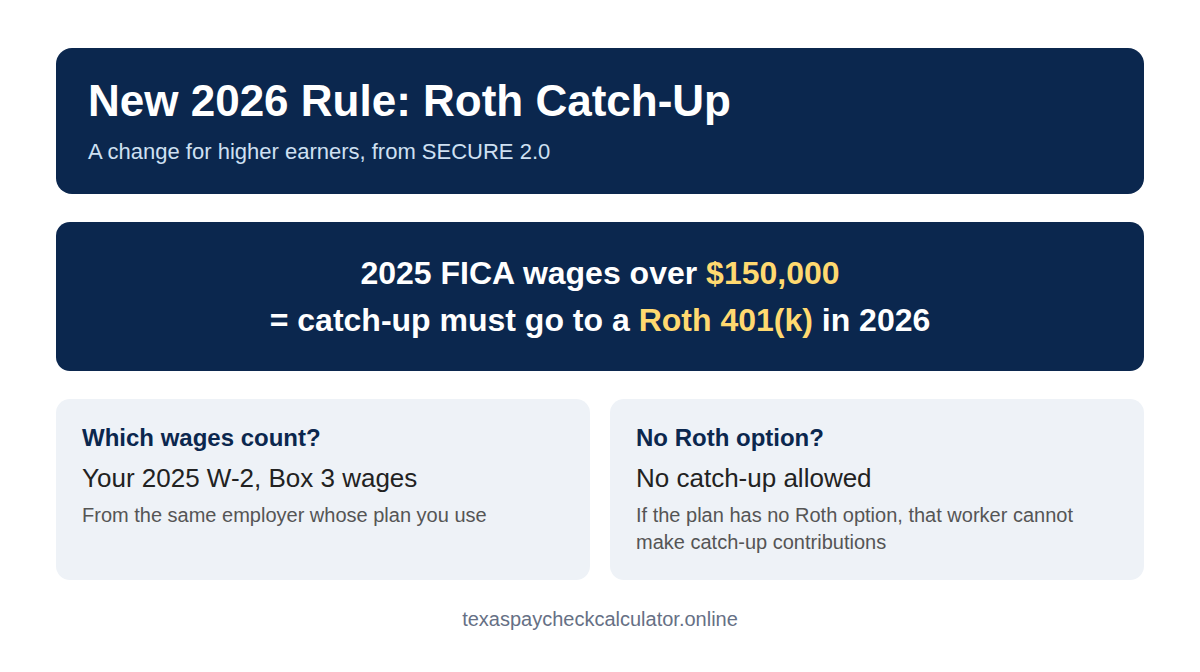
From 2026, under SECURE 2.0, a worker whose wages passed a set threshold in the year before must make all catch-up contributions on a Roth basis. For catch-ups made in 2026, the test looks back at 2025: if the worker’s 2025 FICA wages from that employer — Box 3 of the Form W-2 — were over $150,000, every dollar of the 2026 catch-up must go into the Roth side of the 401(k).
Roth money works the opposite way to pre-tax money: it is taxed now, as part of normal pay, and qualified withdrawals in retirement then come out tax-free, including the growth. So the rule does not change how much a high earner can save — the catch-up is still $8,000, or $11,250 at ages 60 to 63. It changes only the timing of the tax: no upfront break on the catch-up, tax-free money later instead.
There is also a trap. If the plan offers no Roth option at all, a worker over the threshold cannot make catch-up contributions in 2026; there is no fallback to make them pre-tax instead. Workers near the threshold should check early in the year what their 2025 Box 3 wages were, and whether the plan has a Roth feature.
Here is one worked example. A worker is 58 in 2026, and her 2025 FICA wages from her employer were $165,000 — over the threshold, so the rule applies. Her catch-up is $8,000, and in 2026 all of it must go into her Roth 401(k). If she is in the 22% federal tax bracket, the tax on it is simple: $8,000 multiplied by 22% is $1,760, paid now because the $8,000 did not reduce her taxable pay. Had it gone in pre-tax, she would have saved that same $1,760 in 2026, but the $8,000 and its earnings would have been taxed on withdrawal in retirement. The rule swaps a tax charge later for one now; it does not create a new charge.
Employer Contributions and the Combined $72,000 Limit
The $24,500 limit covers only the worker’s own money. Employers can add money too, through a match or a separate employer contribution.
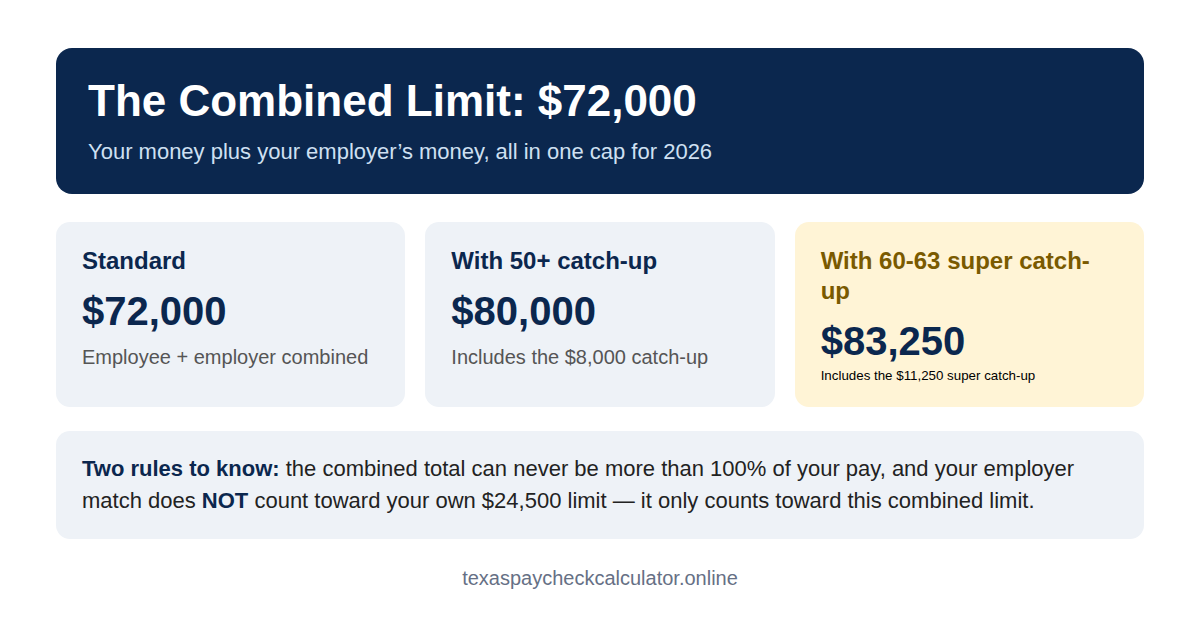
There is, however, a second, larger limit covering everything that goes into the account in one year. For 2026, the combined limit is $72,000, and it can never be more than 100% of the worker’s pay.
That total is made up of the worker’s contributions, the employer’s match, any other employer contributions, and, where a plan allows them, after-tax contributions. With a catch-up, the combined ceiling rises to $80,000, and to $83,250 for a worker aged 60 to 63 using the super catch-up — simple additions again: $72,000 plus $8,000, and $72,000 plus $11,250.
Does the Employer Match Count Toward My $24,500?
No — and this is one of the most common points of confusion. The match counts only toward the combined $72,000 limit, so a worker can still put in the full $24,500 of his or her own money even if the employer adds several thousand more on top. That is also why taking the full match matters: it is extra money, in effect part of the pay package, that uses up none of the worker’s own allowance.
After-Tax Contributions and the Mega Backdoor Roth
Some plans allow a third kind of contribution, called an after-tax contribution — not the same as a Roth contribution. After-tax contributions can continue after the worker has filled the $24,500 limit, up to the combined $72,000 ceiling. The money grows tax-deferred, but earnings are taxed on withdrawal — unless the worker moves it into a Roth account, a strategy often called a mega backdoor Roth.
This is an advanced option — not every plan allows it, and the tax steps must be handled carefully.
Traditional vs Roth 401(k): One Shared Limit
Many employers offer both a traditional and a Roth 401(k) in the same plan. The choice is a tax choice, not a limit choice, because both share the single $24,500 limit — or $32,500 or $35,750 with a catch-up.
A traditional contribution goes in before income tax is worked out: taxable pay falls now, and tax is paid later, on withdrawals in retirement. A Roth contribution goes in after tax: the paycheck feels smaller today, but qualified withdrawals in retirement are tax-free.
A worker can split money between the two in any proportion the plan allows, as long as the total stays inside the one limit. Unlike a Roth IRA, a Roth 401(k) has no income ceiling.
How Much Per Paycheck to Max Out Your 401(k) in 2026
An annual limit is hard to act on — nobody is paid once a year. What a worker actually sets in payroll is a percentage or a dollar amount per paycheck, so it helps to turn the annual figures into paycheck figures.
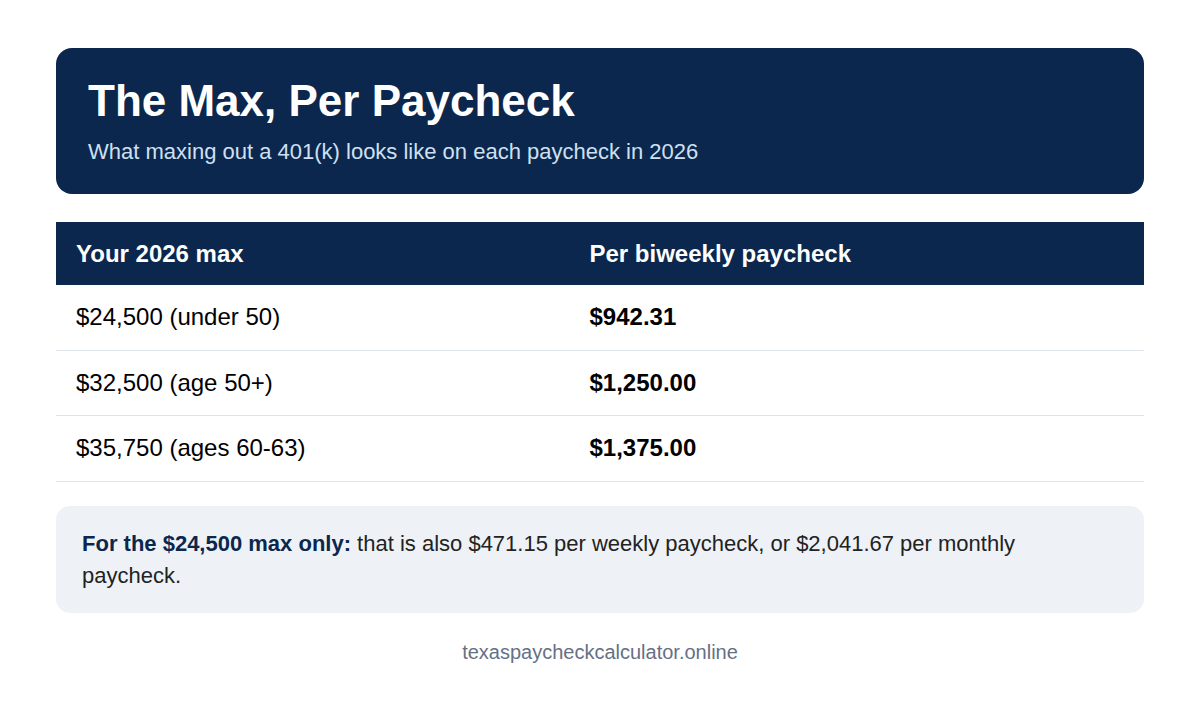
The table below divides each annual employee limit by the number of paychecks in a year for each common pay frequency, rounded to the nearest cent.
| Age group — annual limit | Weekly (52 checks) | Biweekly (26 checks) | Semimonthly (24 checks) | Monthly (12 checks) |
|---|---|---|---|---|
| Under 50 — $24,500 | $471.15 | $942.31 | $1,020.83 | $2,041.67 |
| 50 to 59, and 64 or over — $32,500 | $625.00 | $1,250.00 | $1,354.17 | $2,708.33 |
| 60 to 63 — $35,750 | $687.50 | $1,375.00 | $1,489.58 | $2,979.17 |
A biweekly worker under 50 who wants the maximum needs $942.31 from every one of the 26 paychecks; a biweekly worker in the 60 to 63 group needs $1,375.00 per check. That is a large slice of pay, which is why starting in January matters: a worker who only raises the contribution in July has half as many paychecks left and would need roughly double the per-check amount.
Three warnings belong with this table. First, bonuses change the maths: if a plan takes the same percentage from a bonus check, a large bonus can push contributions up faster than expected, or even over the limit, as covered later in this guide.
Second, filling the limit very fast can cost the worker part of the employer match. Many employers match paycheck by paycheck, so a worker who fills the whole $24,500 by June and then contributes nothing may get no match in the later months. Some plans fix this with a year-end true-up payment; many do not, so spreading contributions evenly is usually safer.
To see what a contribution does to the actual money in the bank, a worker can run his or her own pay through the Texas Paycheck Calculator on this site, and check the take-home result with the Texas Net Pay Calculator.
How a 401(k) Contribution Changes a Texas Paycheck
The limits explain how much can go in. This section explains what that money does to a Texas paycheck, line by line — and one part of it surprises almost everyone.
On a pay stub, a 401(k) contribution appears in the deductions part of the document, with the other benefit costs, between the earnings at the top and the final net pay at the bottom. Most stubs show the current period amount and a year-to-date total beside it, and many put pre-tax and Roth amounts on separate lines, because the two are treated differently for tax.
The first effect of a pre-tax contribution is on federal income tax. It is taken out before federal tax is worked out, so the pay federal withholding is calculated on falls by the amount of the contribution. The tax withheld will not fall by the full contribution — it falls by a share of it — but pre-tax saving always lowers federal tax withheld now.
The second effect is the surprise. A 401(k) contribution does not reduce Social Security or Medicare tax at all. Those charges, together called FICA, are calculated on the full gross pay before the 401(k) deduction is taken: FICA is charged first, on the whole amount. Social Security takes 6.2% and Medicare takes 1.45% — a combined 7.65% — on pay that includes the part going into the 401(k).
The third effect is a Texas effect. Texas has no state income tax, so there is no state withholding line on a Texas stub to change; in an income-tax state, a pre-tax contribution often lowers state withholding too. In Texas the whole tax effect is federal, plus FICA — earnings, the 401(k) line, FICA, federal withholding, other benefit costs, then net pay.
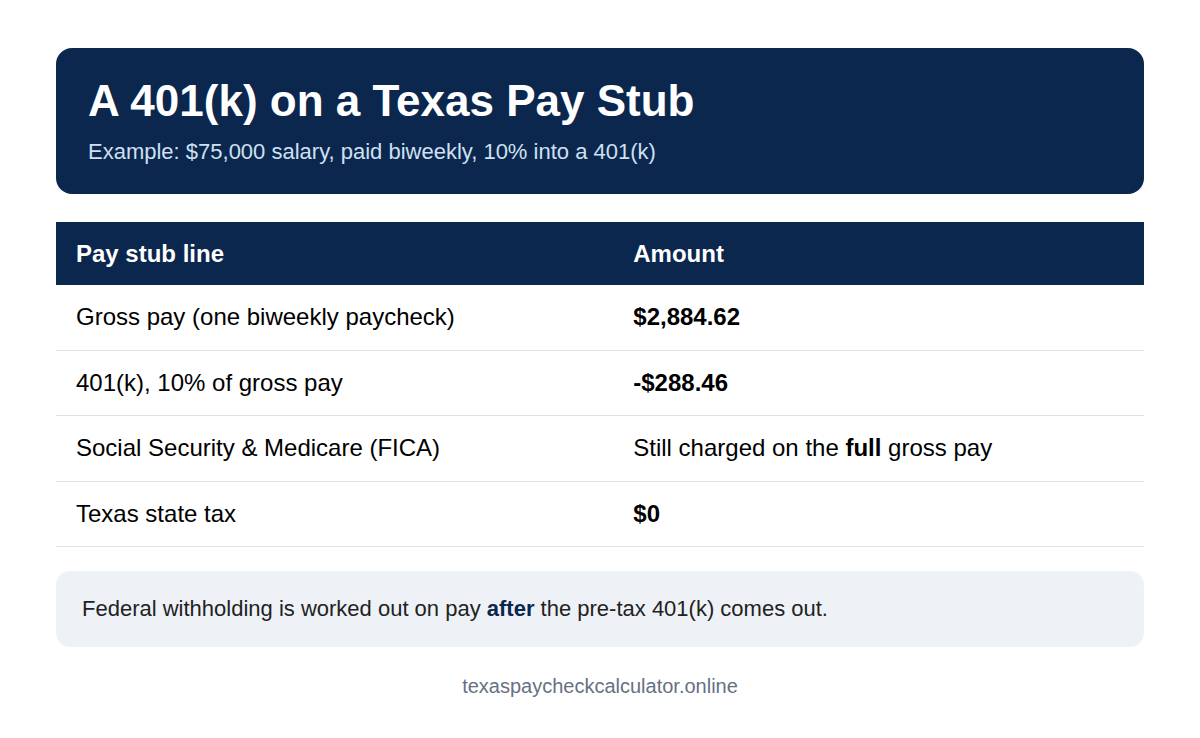
Here is a worked example, using simple arithmetic only, step by step. Take a Texas worker with a salary of $75,000 a year, paid biweekly, who contributes 10% of pay to a traditional 401(k).
Step 1: gross pay per paycheck. $75,000 divided by 26 paychecks is $2,884.62 per check.
Step 2: the 401(k) contribution. 10% of $2,884.62 is $288.46 per check — $7,500 over a full year at 10% of salary, well inside the $24,500 limit.
Step 3: FICA, charged on the full gross pay before the 401(k) deduction. 7.65% of $2,884.62 is $220.67. Notice the base: it is the full $2,884.62, not the smaller amount left after the 401(k) comes out. The $288.46 contribution did not reduce this charge by a single cent.
Step 4: the pay that federal withholding is worked out on. $2,884.62 minus the pre-tax contribution of $288.46 is $2,596.16. Federal withholding is calculated from that $2,596.16 figure, not from the full gross pay. That gap of $288.46, repeated across 26 paychecks, is where the tax saving from a traditional 401(k) comes from.
Step 5: what has gone before federal withholding is even applied. $2,884.62 minus the $288.46 contribution, minus the $220.67 of FICA, leaves $2,375.49 — and federal withholding and any other benefit costs, such as health insurance, still have to come out of that before final net pay is reached.
If the same worker chose a Roth 401(k) instead, steps 1 to 3 — including the FICA charge of $220.67 — would be identical. Only step 4 would change: a Roth contribution does not reduce the pay federal withholding is based on, so that figure would stay at the full $2,884.62.
To see each of these lines on a real document, a reader can work through the guide to How to Read a Pay Stub on this site, which walks through a complete stub line by line.
Limits for Highly Compensated Employees
One more set of limits applies only to higher-paid workers. A worker can be classed as a highly compensated employee, or HCE, in one of two ways: an ownership test — owning more than 5% of the business counts, whatever the salary — or a pay test, for a worker whose compensation passes the threshold, $160,000 being the figure used for 2026, and who sits in the top-paid group at the company.
The label exists for fairness testing. Each year, a plan must pass checks called the ADP and ACP tests, which compare how much the highly paid group saves, as a share of pay, with how much everyone else saves. If the highly paid group saves far more, the plan fails — and part of the HCEs’ contributions can then be handed back as a taxable refund, even if they stayed carefully under the $24,500 limit.
What If You Contribute Too Much?
Going over the employee limit is called an excess deferral, and it happens more easily than people expect. The classic case is a worker with two jobs in one year: each employer can only see its own plan, so neither system notices that the two totals together have passed the limit. A mid-year job change creates the same risk, as does a large bonus taken at the full contribution percentage.
The fix is clear, if done in time. The worker should tell the plan administrator as soon as the mistake is spotted and ask for the extra amount, plus any earnings on it, to be paid back out by April 15 of the following year. If that deadline is missed, the extra amount is taxed in the year it went in — because it should never have had the tax break — and then taxed again when it eventually comes out. That double tax is entirely avoidable with one phone call made in time.
401(k) vs IRA Limits for 2026
An individual retirement account, or IRA, has its own, much smaller limit — and a worker is allowed to have both accounts at the same time.
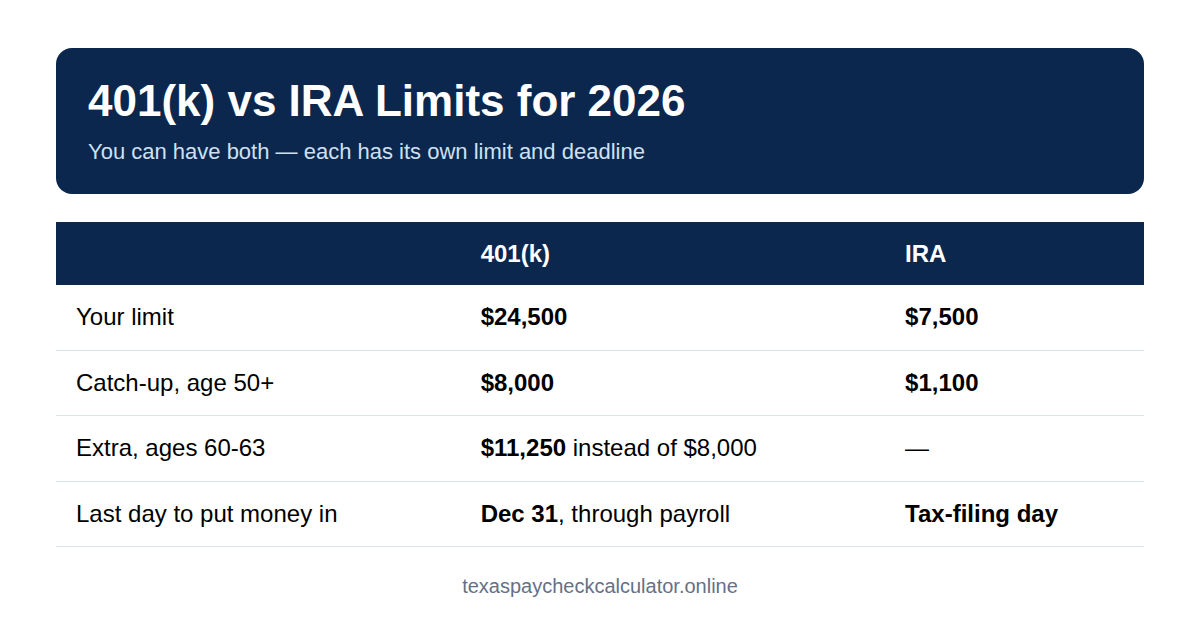
| Limit for 2026 | 401(k) | IRA |
|---|---|---|
| Normal contribution limit | $24,500 | $7,500 |
| Catch-up at 50 and over | $8,000 | $1,100 |
| Extra catch-up at 60 to 63 | $11,250 instead of $8,000 | None |
| Most a worker aged 50+ can put in | $32,500 | $8,600 |
| Last day to contribute for 2026 | December 31, 2026 | The tax-filing deadline in 2027 |
The IRA total is a simple addition: $7,500 plus the $1,100 catch-up gives $8,600 at 50 or over. Even so, the gap is large — a 401(k) allows more than three times as much normal saving — which is why the usual order is to take the full employer match in the 401(k) first, then consider an IRA, then return to the 401(k) if more can be saved.
The deadline row matters too: an IRA contribution for 2026 can still be made in early 2027, up to the tax-filing deadline, but a 401(k) contribution has to come out of a paycheck dated in 2026. Once the last December payroll has run, the 2026 limit is closed for good.
How to Make the Most of the 2026 Limits
First, contribute at least enough to get the full employer match, if one is offered. It is extra pay that does not count against the personal limit. A worker unsure what a raise or a new salary would do to that plan can test the numbers with the Texas Salary Calculator before changing anything in payroll.
Second, raise the contribution a small step at a time — 1% or 2% of pay, timed to land with a pay rise or a bonus. It is barely noticed in take-home pay but builds steadily.
Third, spread contributions across the whole year, so filling the limit early does not cut off months of employer matching, and re-check the percentage after every pay change, job change, or birthday that moves the worker into a new age group above. Turning 50, or reaching 60, quietly raises the ceiling — and a percentage set at age 48 will not use the extra room on its own.
Frequently Asked Questions
1. What is the 401(k) contribution limit for 2026?
$24,500 for a worker under 50, across all 401(k) plans combined.
2. What is the catch-up limit in 2026?
$8,000 at age 50 or over, for a total of $32,500 — or $11,250 at ages 60 to 63, for a total of $35,750.
3. Does my employer match count toward my limit?
No. The match counts only toward the combined employee and employer limit, not toward the personal $24,500 limit.
4. What is the combined employee and employer limit?
$72,000 for 2026, or 100% of the worker’s pay, whichever is less — rising to $80,000 with the 50+ catch-up, and $83,250 at ages 60 to 63.
5. I have two jobs and two 401(k)s — is the limit per plan?
No, it is per person. Contributions to both plans are added together and must stay within the one annual limit for the worker’s age group.
6. What is the new Roth catch-up rule for 2026?
If a worker’s 2025 FICA wages from the employer — Box 3 of the Form W-2 — were over $150,000, all 2026 catch-up contributions must go into a Roth 401(k). If the plan has no Roth option, the worker cannot make catch-up contributions.
7. Can I contribute to a 401(k) and an IRA in the same year?
Yes. The limits are separate: up to $24,500 into a 401(k) and up to $7,500 into an IRA for 2026, with catch-ups on top of both at 50 and over.
8. What happens if I go over the limit?
The extra amount is an excess deferral. Ask the plan administrator to return it, plus any earnings on it, by April 15 of the following year; if that deadline is missed, it can be taxed twice — in the year it went in, and again when withdrawn.
9. When is the last day to contribute for 2026?
December 31, 2026. A 401(k) contribution must come out of a paycheck dated within 2026, unlike an IRA, which can be funded up to the tax-filing deadline the following spring.
10. Do the same limits apply to 403(b) and 457 plans?
Yes, in the main: the same $24,500 employee limit and the same catch-ups apply to 403(b) plans, governmental 457(b) plans and the federal Thrift Savings Plan, with only small extra catch-up rules in some 403(b) and 457 plans.
Conclusion
The 401(k) contribution limits for 2026 give Texas workers more room than last year: $24,500 under 50, $32,500 at 50 and over, and $35,750 in the short 60 to 63 window, with a combined ceiling of $72,000 once employer money is counted. The new Roth catch-up rule is the one change that needs action early, and only for higher earners.
The simplest next step is a small one: take the limit for the right age group, divide it by the number of paychecks in the year, and set that figure — or a realistic step toward it — in payroll now, while the whole of 2026 is still available to spread it across.