
If a workweek in Texas runs past 40 hours, the paycheck for that week should look different from a normal week. That difference is overtime pay, and it is one of the most misunderstood parts of a Texas paycheck. Many workers know the phrase “time and a half,” but fewer know when it starts, how the rate is worked out, or what to check when the numbers do not add up.
This guide explains Texas overtime pay in plain language. It follows the same pattern as the pay-stub guide on this site: the rules first, then the calculation, then worked examples, then the mistakes people most often make. It is written for workers, not lawyers, and it is general information rather than legal advice.
The examples use round numbers so a reader can follow the maths and then check a real pay stub against the same steps.
Key Takeaways
- In Texas, overtime generally starts after 40 hours worked in a single workweek, and the rate is 1.5 times the regular rate of pay.
- Texas does not have its own overtime law for private-sector workers. The federal Fair Labor Standards Act, known as the FLSA, sets the rule.
- There is no daily overtime rule in Texas. A long day on its own does not create overtime unless the weekly total passes 40 hours.
- The regular rate is not always the basic hourly wage. Certain bonuses, commissions, and shift differentials must be included first.
- A worker can check overtime on a pay stub by comparing the overtime hours and the overtime rate with the hours actually worked.
Texas at a Glance: One Rule Across a Very Large State
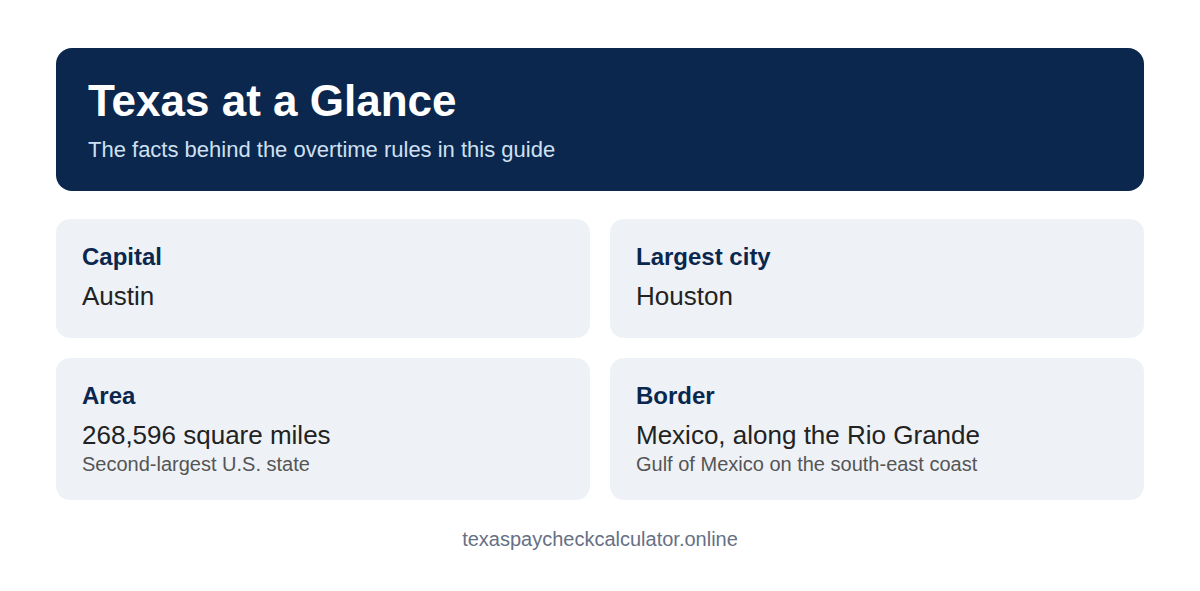
Texas is a state where the same overtime rule applies from one border to the other, even though the work itself looks very different from place to place. A nurse in Houston, a warehouse worker in Dallas, a teacher’s aide in Austin, and a refinery worker on the Gulf Coast are all covered by the same federal test, because Texas has not written a separate state overtime statute for private-sector workers. That single-rule point matters for a state this large, and it is worth keeping in mind before the details begin.
The population of Texas is among the largest in the United States, and its workers live in large cities and in smaller towns alike. The big metropolitan areas around Houston, Dallas-Fort Worth, Austin, and San Antonio hold millions of people, and each of those places has its own mix of jobs: hospitals, schools, warehouses, offices, airports, and energy plants.
A worker at an international airport in Houston or Dallas, a member of staff at a university in Austin, or a classroom worker at a school in San Antonio may all face the same weekly question at the end of a long week: did the week pass 40 hours, and was the extra time paid at the right rate?
In San Antonio, for example, hospital and school staff work long weeks just like workers in other large cities, and many Texans in those jobs are part of a wider American workforce that is covered by the same federal overtime test. Workers in other states face the same federal floor, although some states add their own rules on top, which is why the Texas versus California comparison later in this guide is useful.
The Regions and Landscapes of Texas
The regions of Texas are often described by their land, and a quick Texas map shows why one rule still has to cover so much variety. Look at any map of the state, and the pattern is clear: a worker in one corner and a worker in the opposite corner are both in North America, both in the same state, and both under the same federal rule. On a map, the border with Mexico is long, and towns on both sides of it share workers, families, and trade.
In Spanish, the country is written México, and workers from Northern Mexico also cross into Texas border towns for work, while Mexican communities on the Texas side have deep roots in the state, and Mexican-American workers form a large part of the workforce in many border cities. In the East Texas pine country, in Central Texas around Austin, and in West Texas toward the New Mexico border, the jobs, the weather, and even the annual rainfall change a great deal. The Gulf Coast and the Gulf Coastal Plains sit low and humid near the Gulf of Mexico, while the Great Plains and the Central Plains stretch wide and open farther north.
The Edwards Plateau rises in the centre of the state, the Llano Estacado spreads across the high plains of the west, and the Caprock Escarpment marks the edge where that high country drops away. Farther west again, the Basin and Range province brings a different kind of dry, mountain country.
Water draws many of the state’s natural lines. The Rio Grande forms a long southern border with Mexico, the Red River marks much of the northern edge, and the Sabine River runs along the eastern side toward Louisiana. The Rio itself is not just a line on a map; it is a working river for farms, towns, and border communities, and the Grande in its name is a reminder of how long that river has shaped the region.
Texas also contains the Guadalupe Mountains in the far west, where Guadalupe Peak stands as the highest point in the state, and the Guadalupe Mountains are protected today as a national park. Other national parks and protected places in Texas draw visitors from across the country and the world, but most Texans meet the state’s size in a more ordinary way: in the miles they drive to work, in the size of a county, and in the distance between one job center and the next.
The East of the state is pine country, the West is drier and more open, and the south of the state runs down to the border, while the south-eastern corner meets the coast. The Interior Lowlands sit in the far east of the state, and each region has its own mix of jobs, just as each region of the country does. The regions of the state therefore differ in landscape, but not in the overtime test.
Ports and refineries on the Gulf employ large numbers of shift workers, and other workers on the Gulf coast, along the coast itself and inland from the coast, all work under the same weekly rule.
In area terms, Texas covers more than 260,000 square miles, which is a useful way to picture the scale, even if a single square mile of city land and a single square mile of ranch land feel nothing alike. The area of the state is divided into many areas of work, from coastal ports to inland plains, and the plains themselves are only part of the story. A worker’s overtime rights do not change when the landscape changes, and that is the point of this section: whether a person works on the coast, on the plains, or in a city centre, the 40-hour test is the same.
A Short History, in Plain Terms
| Texas Region | What It Is Like |
|---|---|
| Gulf Coast and Gulf Coastal Plains | Low, humid country near the coast, with ports and refineries |
| Great Plains and Central Plains | Wide, open plains in the north and centre |
| Edwards Plateau | Higher country in the centre of the state |
| Llano Estacado and Caprock Escarpment | High plains in the west, ending at a steep edge |
| Far west mountains | Dry mountain country, including the Guadalupe Mountains |
Texas history helps explain why the state feels distinct, even though its modern overtime rules come from federal law. The land was once called Tejas, and in the 19th century it moved through a remarkable sequence: the Texas Revolution, the short-lived Republic of Texas, and then admission to the Union. Sam Houston is the best-known figure of that era, and the Texas republic he helped lead gave the state a strong sense of its own identity. The Consultation of 1835 created a provisional government, and the Runaway Scrape — the flight of settlers eastward during the revolution — remains one of the most vivid episodes of that period.
Later, in the Civil War, Texas adopted an ordinance of secession, and secession itself became a defining and painful chapter in the state’s story. The war changed the nation, and Texas changed with it. In the 20th century and into the 21st century, Texas politics, business, and population all grew rapidly, and the state’s modern government — including the federal government’s role in labour law — took the shape workers know today.
Modern party politics, with the Republican Party and the Democratic Party both active in the state, has even produced famous episodes such as the Texas Eleven, when a group of senators left the state in 2003 to break a quorum. None of that history created the modern overtime rule, and this guide does not pretend otherwise. It simply places today’s workers in a state whose past is unusually eventful, and whose present workforce is unusually large.
Work in this century looks very different from work in earlier centuries, and Texas is now among the largest of the U.S. states by population and by area.
Demographic research also helps describe that workforce. Studies of the state’s population, including work by the Public Religion Research Institute on faith and public life, are sometimes used to describe how diverse Texas has become, but overtime law does not depend on those findings. What matters for pay is simpler: hours worked, the regular rate, and whether the worker is exempt or non-exempt.
What Is Overtime Pay?
Overtime pay is premium pay for hours worked beyond the standard workweek. It is not a bonus, and it is not a favour an employer does for a worker who stays late. For a non-exempt worker, any hour worked past 40 in a single workweek must be paid at at least 1.5 times the worker’s regular rate. The worker’s regular rate is the true hourly value of the work for that week, not always the basic hourly wage, as the calculation section below explains.
The idea is easier with one example. If the regular rate is 20 dollars an hour, the overtime rate is 30 dollars an hour: 50 percent higher. If a worker works 45 hours in a week at that rate, the first 40 hours are paid at 20 dollars and the extra 5 hours are paid at 30 dollars.
Two ideas must stay separate here. The threshold is 40 hours, and the rate is 1.5 times the regular rate. An error in either one changes the paycheck. A worker who is paid straight time for overtime hours, or whose bonus is left out of the regular rate, is being underpaid even if the hours themselves are recorded correctly.
Texas Overtime Rules at a Glance
Texas does not have a separate overtime statute for private-sector workers, so the federal Fair Labor Standards Act governs. The U.S. Department of Labor enforces the FLSA, and the Texas Workforce Commission handles wage claims under the Texas Payday Law. The deadlines for those two routes are different, and the deadlines section near the end of this guide explains why that difference matters.
The core rules are:
- A workweek is a fixed period of seven consecutive 24-hour periods, which is 168 hours in total. The employer chooses when the workweek starts, and it does not have to start on Monday.
- Overtime is due for hours worked over 40 in that single workweek. Each workweek stands alone.
- Hours cannot be averaged over two weeks. A worker who works 50 hours in one week and 30 hours in the next is still owed 10 hours of overtime for the first week.
- There is no daily overtime rule in Texas. A single 12-hour shift does not create overtime on its own if the weekly total stays at or below 40 hours.
- Weekend, night, or holiday work does not automatically create overtime. Only the weekly total matters, unless a contract or an employer policy promises extra pay.
- There is no double-time requirement. Double time is paid only if an employer policy or a contract promises it.
Texas follows the federal minimum wage of 7.25 dollars an hour, so the minimum-wage overtime rate is 10.88 dollars an hour, which is 7.25 dollars multiplied by 1.5 and rounded. That figure is a floor, not a typical rate: most workers earn more, and their overtime rate is 1.5 times their own regular rate.
| Rule | What It Means |
|---|---|
| Hours in a workweek | Overtime after 40 hours actually worked |
| Overtime rate | 1.5 times the regular rate |
| Long single day | No daily overtime on its own |
| Weekend or holiday work | No automatic overtime, unless the weekly total passes 40 |
| Double time | Not required by law, only by contract or policy |
| Minimum wage overtime rate | 10.88 dollars an hour |
The same test applies in East, West, and Central Texas, because the rule is federal. Workers in other U.S. states face the same federal floor, although some states add daily overtime rules on top of it. A worker who works four 10-hour days in Texas earns no overtime for that week, because the total is 40 hours; in California, the same schedule would create overtime, because California counts hours over eight in a day.
Who Gets Overtime in Texas? Exempt Versus Non-Exempt
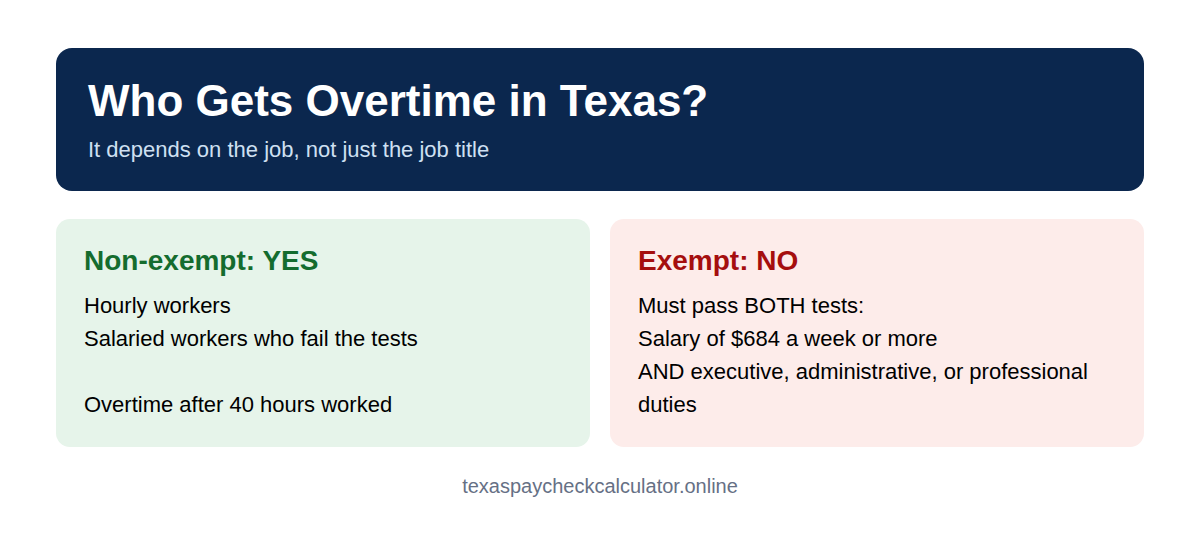
Before any calculation, the classification question has to be answered: is the worker exempt or non-exempt? Non-exempt workers are entitled to overtime pay. Exempt workers are not, even if they work very long weeks. Most hourly workers are non-exempt, including warehouse workers, retail workers, restaurant workers, care workers, drivers, and skilled trades workers.
The main exempt categories are executive, administrative, professional, computer, and outside sales workers. To be exempt, a worker must meet both a salary test and a duties test. The salary threshold enforced today is 684 dollars a week, paid on a salary basis. The duties test looks at what the worker actually does: managing a department and supervising at least two full-time employees, office work that needs real discretion and judgement, or work that needs advanced knowledge or original creative skill.
There is also a highly compensated employee category. A worker paid at least 107,432 dollars a year can be exempt if the worker regularly performs at least one qualifying exempt duty. Below that level, the full duties test still applies.
Two misunderstandings cause most classification mistakes. First, being paid a salary does not by itself make a worker exempt. Second, a job title does not decide the question: a worker called a manager who mainly does manual work or customer service may still be non-exempt. Misclassification is common, especially for day-rate workers and for workers in oil, gas, and construction.
Salaried non-exempt workers are a special case. Their weekly salary is converted to an hourly rate, usually by dividing by 40, and overtime is paid on top for hours over 40. The method changes if the salary was meant to cover more than 40 hours, which is why the worked examples below show both versions. A Texas salary calculator can help a salaried worker see what a weekly salary means per hour, but the overtime question still depends on the classification and on the regular rate.
Certain groups sit outside the usual rules. Most agricultural workers are exempt from FLSA overtime, and Texas has not added a state law extending overtime to them. Independent contractors are not employees for FLSA purposes, so the overtime rules do not apply to them in the same way.
| Worker Type | Overtime? |
|---|---|
| Hourly non-exempt worker | Yes, after 40 hours |
| Salaried non-exempt worker | Yes, after 40 hours, on a converted hourly rate |
| Executive, administrative, or professional worker who meets salary and duties tests | No, exempt |
| Computer or outside sales worker who meets the tests | No, exempt |
| Most agricultural workers | No, exempt under federal law |
How Overtime Pay Is Calculated, Step by Step
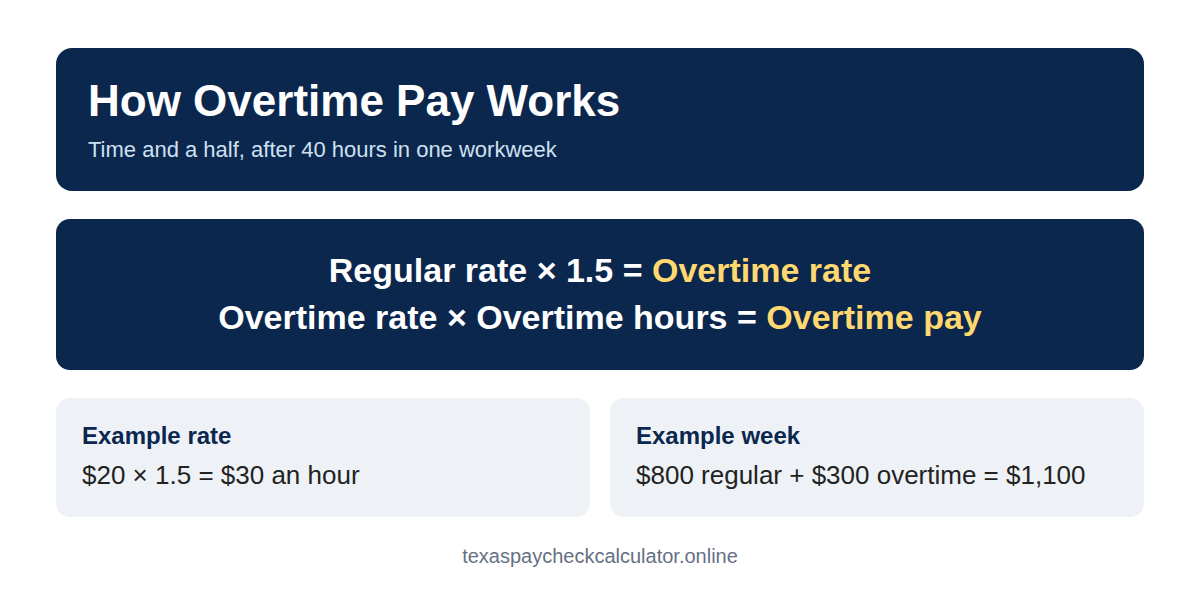
The calculation has four steps, and most pay-stub errors happen in step one.
Step 1: Find the Regular Rate
The regular rate is the true hourly value of the work for that week. For a straightforward hourly worker, it is usually the hourly wage. For other workers, it is more: non-discretionary bonuses, commissions, and shift differentials earned that week must be folded into the regular rate before the overtime rate is worked out.
Some payments are excluded: small gifts, genuinely discretionary bonuses where neither the fact of the bonus nor the amount was promised in advance, and reimbursements for actual business expenses. The general rule is that a payment that was promised or tied to performance usually counts, while a true surprise gift usually does not.
Step 2: Count the Overtime Hours
Only hours actually worked count toward the 40-hour threshold. Paid vacation, sick leave, and holidays that were not worked generally do not count. A worker who actually works 42 hours in a week that also contains a paid holiday still has 42 hours for overtime purposes, not 50. A worker who works 38 hours and takes 8 hours of paid holiday has 38 hours for overtime purposes, not 46.
Step 3: Multiply the Overtime Rate by the Overtime Hours
The overtime rate is the regular rate multiplied by 1.5. Multiply that rate by the number of overtime hours to get the overtime pay.
Step 4: Add Regular Pay and Overtime Pay
The total weekly gross pay is the regular pay for the first 40 hours plus the overtime pay for the extra hours.
- Overtime rate = regular rate x 1.5
- Overtime pay = overtime rate x overtime hours
- Total weekly gross pay = (40 x regular rate) + overtime pay
Worked Examples
The examples below use the same style as the calculator pages on this site: round numbers, a clear breakdown, and a total the reader can check. To check a real week, use the same steps with the real hours and the real regular rate, or run the numbers through the Texas paycheck calculator and compare the result with the pay stub.
| Example | Regular Rate | Hours | Total Pay |
|---|---|---|---|
| 1. Twenty dollars an hour | 20 dollars | 50 | 1,100 dollars |
| 2. Eighteen dollars an hour | 18 dollars | 47 | 909 dollars |
| 3. Texas minimum wage | 7.25 dollars | 45 | 344.40 dollars |
| 4. Salaried non-exempt | 25 dollars an hour (from 1,000 dollars a week) | 48 | 1,300 dollars |
| 5. Hourly plus bonus | 13 dollars corrected rate | 46 | 637 dollars |
| 6. Exactly forty hours | 18 dollars | 40 | 720 dollars |
Example 1: Twenty Dollars an Hour, Fifty Hours
Regular pay: 40 x 20 dollars = 800 dollars. Overtime rate: 20 dollars x 1.5 = 30 dollars. Overtime pay: 10 x 30 dollars = 300 dollars. Total: 800 dollars + 300 dollars = 1,100 dollars.
Example 2: Eighteen Dollars an Hour, Forty-Seven Hours
Regular pay: 40 x 18 dollars = 720 dollars. Overtime rate: 18 dollars x 1.5 = 27 dollars. Overtime pay: 7 x 27 dollars = 189 dollars. Total: 720 dollars + 189 dollars = 909 dollars.
Example 3: Texas Minimum Wage
A worker on the Texas minimum wage of 7.25 dollars an hour works 45 hours. Regular pay: 40 x 7.25 dollars = 290 dollars. Overtime rate: 7.25 dollars x 1.5 = 10.88 dollars, rounded. Overtime pay: 5 x 10.88 dollars = 54.40 dollars. Total: 290 dollars + 54.40 dollars = 344.40 dollars.
Example 4: Salaried Non-Exempt Worker
A salaried non-exempt worker is paid 1,000 dollars a week for a 40-hour week and works 48 hours. Regular rate: 1,000 dollars / 40 = 25 dollars an hour. Overtime rate: 25 dollars x 1.5 = 37.50 dollars. Overtime pay: 8 x 37.50 dollars = 300 dollars. Total: 1,000 dollars + 300 dollars = 1,300 dollars.
If the same salary was meant to cover 48 hours, the method changes: the salary already paid straight time for all 48 hours, so only the extra half-time premium is owed on the 8 overtime hours. That is the fluctuating workweek idea, explained in the pay structures section below.
Example 5: Hourly Worker With a Weekly Bonus
A worker earns 12 dollars an hour, works 46 hours, and earns a 46-dollar production bonus for the week. Straight-time earnings: 46 x 12 dollars = 552 dollars. Total including the bonus: 552 dollars + 46 dollars = 598 dollars. Regular rate: 598 dollars / 46 = 13 dollars. Overtime rate: 13 dollars x 1.5 = 19.50 dollars. Regular pay on the corrected rate: 40 x 13 dollars = 520 dollars. Overtime pay: 6 x 19.50 dollars = 117 dollars. Total: 520 dollars + 117 dollars = 637 dollars. Without the bonus, the week would have paid less, and a stub that used 12 dollars as the regular rate would underpay the overtime.
Example 6: Exactly Forty Hours, No Overtime
A warehouse worker earns 18 dollars an hour and works four 10-hour days, which is 40 hours. Regular pay: 40 x 18 dollars = 720 dollars. Overtime pay: 0 dollars. Total: 720 dollars. The long days feel like overtime, but they are not under Texas and federal law, because the test is weekly, not daily. In California, the same schedule would create overtime, because California counts hours over eight in a day.
Different Pay Structures
Multiple Pay Rates in One Week
When a worker does two jobs at two rates in the same week, the regular rate is the weighted average: total straight-time earnings divided by total hours. For example, 20 hours at 15 dollars plus 20 hours at 25 dollars gives 800 dollars for 40 hours, an average of 20 dollars an hour, and the 5 extra hours in a longer week would use that weighted average as the regular rate.
Commission and Piece-Rate Workers
Commission and piece-rate workers are entitled to overtime like other non-exempt workers. Their straight-time earnings already cover all hours worked, so the total weekly earnings divided by total hours gives the regular rate, and only the extra half-time premium is added on top. For example, a worker paid 10 dollars an hour plus 100 dollars of commission in a 45-hour week has total earnings of 550 dollars, a regular rate of about 12.22 dollars an hour, and a premium of about 6.11 dollars an hour for the 5 overtime hours, which is about 30.56 dollars of total premium.
Tipped Employees
For tipped employees, the regular rate is the direct cash wage plus the tip credit, not the cash wage alone. In Texas, the direct cash wage can be as low as 2.13 dollars an hour, with a tip credit of up to 5.12 dollars, so the regular rate is at least 7.25 dollars. The overtime rate is 1.5 times the full regular rate. The tip credit for overtime hours cannot exceed the tip credit for regular hours. Overtime cash pay can therefore look lower than expected, because part of the rate is covered by tips actually received, but the total must still reach time and a half.
The Fluctuating Workweek Method
Under the fluctuating workweek method, a worker receives a fixed salary that is understood to cover all hours worked, and only the extra half-time premium is owed for overtime hours. This method is only lawful when all of these conditions hold: the hours genuinely fluctuate from week to week, there is a clear mutual understanding that the salary covers all hours, the salary is large enough that it never falls below the minimum wage for any hour worked, and the half-time premium is still paid. If any condition fails, the standard 1.5 method applies instead. Most hourly workers will never meet this method, because they are not paid a fixed salary for fluctuating hours.
What Counts Toward the Forty Hours, and What Does Not
Hours actually worked count toward the 40-hour threshold. That includes time on the job, travel during the workday between job sites, and training or meetings that fail all four conditions for exclusion: outside normal hours, voluntary, not directly related to the job, and no other work done during the session. On-call time counts when the restrictions are so tight that the worker cannot use the time freely, for example when the worker must stay within a few minutes of the workplace.
Ordinary commuting from home to work does not count. Paid time off does not count. A meal break of 30 minutes or more, when the worker is fully relieved of duty, does not count. Short breaks of 20 minutes or less usually count as work time. Time-clock rounding is allowed only if it is neutral over time: rounding to the nearest quarter hour is common, but always rounding down in the employer’s favour is not neutral and is not lawful.
Because the count depends on actual hours, a worker should keep a personal record of hours worked: start and finish times, breaks, and any work done at home or after hours.
| Counts Toward 40 Hours | Does Not Count |
|---|---|
| Hours actually worked | Paid vacation not worked |
| Travel between job sites during the workday | Ordinary commuting from home to work |
| Training that fails the four exclusion conditions | Paid holiday not worked |
| Short breaks of 20 minutes or less | Meal break of 30 minutes or more, fully relieved of duty |
| On-call time with tight restrictions | On-call time when the worker is free to live normally |
Overtime on a Pay Stub: How to Check It
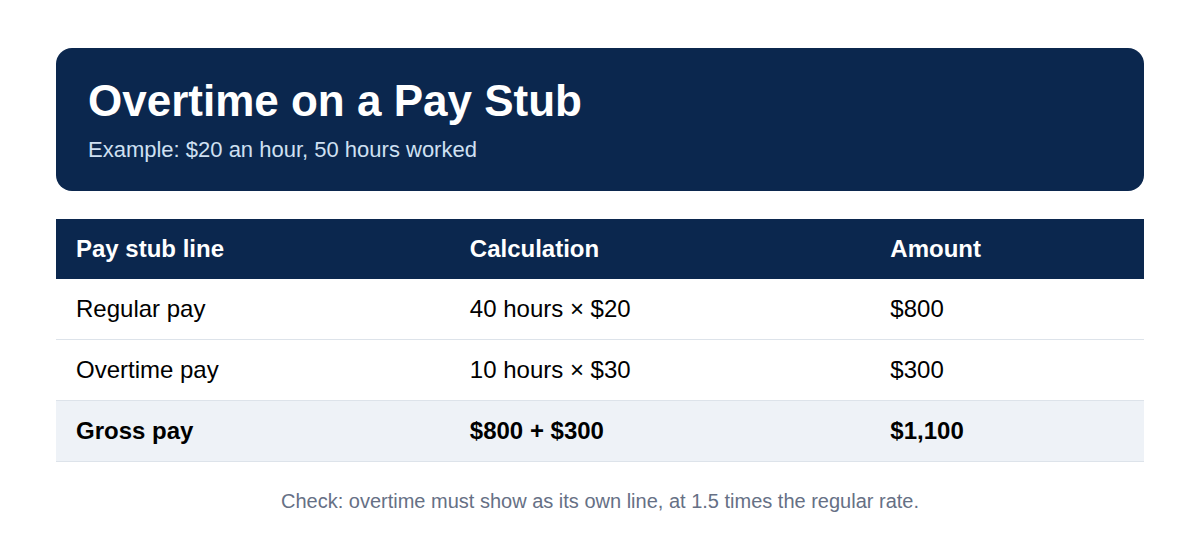
A pay stub should show overtime as its own line, with the hours and the rate, not buried in a single total. To check it:
- Confirm the pay period and the total hours shown.
- Find the regular hours, the overtime hours, and the overtime rate.
- Multiply the overtime hours by the overtime rate and compare the result with the overtime pay shown.
- Check whether any bonus, commission, or shift differential for that week was included in the regular rate.
- Compare the stub total with your own hours record.
If the overtime line is missing, if the overtime rate is the same as the regular rate, or if the hours do not match your own record, ask payroll about it. For help reading the rest of the stub, see how to read a pay stub.
Common Overtime Myths and Mistakes
Only hourly workers get overtime is a myth: salaried non-exempt workers get overtime too. That Texas requires daily overtime is a myth: it does not. That an employer can offer time off instead of overtime pay is wrong for private-sector employers: overtime must be paid in cash at time and a half, while state and local government employers may offer compensatory time under specific caps.
Other common mistakes are paying straight time for overtime hours, averaging hours over two weeks, leaving bonuses or commissions out of the regular rate, and misclassifying workers as exempt. Part-time workers are often assumed to be outside the rules, but a part-time worker who works more than 40 hours in a week earns overtime for those extra hours. A worker cannot waive overtime rights in writing, and unauthorised overtime still counts as work: it must be paid, although the worker may face discipline for breaking a scheduling rule.
Employer errors are usually the same short list: overtime that is missing or unrecorded, rounding that always favours the employer, and payroll systems that do not include bonuses in the regular rate. Payroll audits and clear written overtime policies avoid most of them.
Overtime and Taxes
Overtime is taxed like normal wages. There is no special overtime tax rate, and the idea that overtime can leave a worker worse off is a myth. Extra income can push part of a worker’s income into a higher tax bracket, but only that extra part is taxed at the higher rate, so more overtime still means more take-home pay. To see the effect on a paycheck, use the Texas net pay calculator.
Texas has no state income tax, so overtime is not taxed at the state level. Federal income tax and federal payroll taxes, Social Security and Medicare, do apply. A new federal provision for 2025 to 2028 allows certain non-exempt workers to deduct the premium portion of overtime from federal taxable income, up to 12,500 dollars for a single filer or 25,000 dollars for joint filers. For time-and-a-half pay, the premium portion is the extra half, which is one-third of total overtime pay: for example, 9,000 dollars of total overtime pay gives a premium portion of 3,000 dollars. The deduction is claimed on the federal return, and it does not change how an employer calculates overtime pay. Check current federal guidance before relying on it, and keep overtime records separate from regular pay records, which is another reason to keep them.
Overtime in Texas Versus California
California requires daily overtime after eight hours in a day, and double time after twelve hours. Texas requires overtime only after 40 hours in a week. Four 10-hour days therefore mean no overtime in Texas and eight hours of overtime in California, for the same total hours.
This matters for two reasons. California advice does not apply in Texas, and a worker who moves between states, or who works for a national employer with offices in both states, should check which state’s rule applies to the work actually done.
Mandatory Overtime and Refusing Overtime
A Texas employer can generally require a non-exempt worker to work overtime, and a worker who refuses may face discipline, including termination, unless a contract, a collective bargaining agreement, or another law protects the worker. There are exceptions: Texas law places limits on mandatory overtime for registered nurses and licensed vocational nurses, who generally cannot be required to work beyond pre-scheduled shifts except in a disaster or emergency.
Requiring overtime is separate from paying for it. An employer that requires overtime must still pay time and a half for hours over 40, and an employer cannot retaliate against a worker for filing an overtime wage complaint. The complaint routes are in the next sections, and a worker should keep records of schedules, hours, and pay stubs from the start.
Penalties for Unpaid Overtime
Under a federal claim, a worker who wins can generally recover the unpaid wages plus an equal amount as liquidated damages, which effectively doubles the recovery, plus reasonable attorney’s fees and court costs. Repeated or willful violations can attract civil penalties of up to 1,100 dollars per violation. Employers often audit payroll when a question is raised, because fixing a small error early is usually far cheaper than defending a larger claim. A worker does not need to prove bad faith to recover wages owed: a clear record of hours and pay stubs is usually enough to start a conversation with payroll, and it is essential if the issue does not resolve.
What to Do If Overtime Pay Is Missing or Wrong
- Recheck the stub against your own hours record: the workweek dates, the overtime hours, and the overtime rate.
- Check whether a bonus, commission, or shift differential for that week was included in the regular rate.
- Raise the question with payroll or human resources in writing, and keep a copy of the message and any reply.
- Keep old stubs, schedules, and messages about hours as evidence.
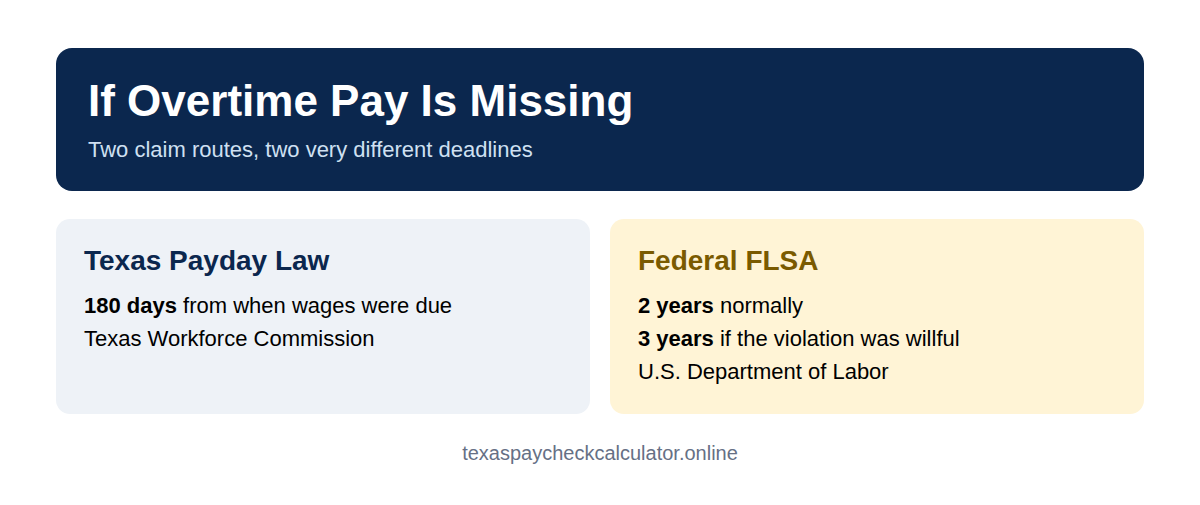
- If the issue is unresolved, consider a wage claim with the Texas Workforce Commission or a complaint to the U.S. Department of Labor’s Wage and Hour Division.
The deadlines differ, and they matter. A Texas Payday Law wage claim generally must be filed within 180 days of when the wages were due. A federal FLSA claim generally has a two-year limit, or three years for willful violations. Department of Labor complaints are kept confidential. A worker whose pay was short more than 180 days ago should look to the federal route, and anyone who is unsure should seek advice promptly, because time limits run from each pay period, not from when the worker first notices the problem. To estimate what a corrected week should have paid, use the Texas take-home pay calculator, remembering that the result is an estimate, not a legal finding.
Frequently Asked Questions
When does overtime start in Texas?
Overtime starts after 40 hours actually worked in a single fixed workweek, for non-exempt workers. The workweek does not have to start on Monday, but it must stay fixed.
Is overtime due after eight hours in a day in Texas?
No. Texas has no daily overtime rule. A long day creates overtime only if the weekly total passes 40 hours.
How much is time and a half in Texas?
Time and a half is 1.5 times the regular rate. At 20 dollars an hour, it is 30 dollars an hour. At the Texas minimum wage of 7.25 dollars, it is 10.88 dollars an hour.
Do salaried employees get overtime in Texas?
Salaried employees get overtime if they are non-exempt, which depends on salary and duties, not on being salaried. Salaried exempt employees do not.
Does Texas require double time?
No. Neither Texas nor federal law requires double time. Double time is paid only if an employer policy or contract promises it.
Do paid holidays count toward overtime hours?
Generally no. Paid holidays, vacation, and sick leave that were not worked do not count as hours worked toward the 40-hour threshold.
Is overtime taxed differently in Texas?
Overtime is taxed like normal wages for federal purposes, and Texas has no state income tax. A separate federal deduction for the premium portion of overtime applies for 2025 to 2028, subject to current federal rules.
Can an employer give time off instead of overtime pay?
For private-sector employers, generally no. Overtime must be paid in cash at time and a half. State and local government employers may offer compensatory time under specific rules and caps.
What if an employer averages hours over two weeks?
Averaging is not allowed. Each workweek stands on its own, so 50 hours in one week and 30 in the next still means 10 hours of overtime for the first week.
How do I check overtime on my pay stub?
Compare the overtime hours and rate on the stub with the worker’s own hours record, multiply hours by rate, and check whether bonuses or commissions for that week were included in the regular rate.
Where can I complain about unpaid overtime in Texas?
A worker can file a wage claim with the Texas Workforce Commission within 180 days, or a complaint with the U.S. Department of Labor’s Wage and Hour Division within two years, or three years for willful violations.
Does overtime apply to part-time workers?
Yes, if a part-time worker works more than 40 hours in a week. Part-time status does not remove overtime rights for those extra hours.
Conclusion
Texas overtime pay is simpler once the weekly test is clear. After 40 hours in a workweek, non-exempt workers earn time and a half on a regular rate that includes bonuses and commissions earned that week. There is no daily rule, no double-time requirement, and no state overtime statute on top of the federal rule.
The habits that protect a worker are simple too: keep a record of hours, check the overtime line on every stub, and raise any mismatch with payroll promptly, before a deadline passes. With those habits, a Texas worker can tell week by week whether the paycheck matches the work actually done.