Wondering what a Texas paycheck looks like after taxes? A salary is only the starting point. Federal income tax and payroll taxes come out before the money reaches a bank account, and knowing how much helps workers budget, compare job offers, and plan their savings.
The good news for workers in Texas is that the state doesn’t tax wages. Unlike residents of many other U.S. states, Texans keep their paycheck free of state income tax. Federal income tax, Social Security, and Medicare still apply.
A Texas Take-Home Pay Calculator (2026) turns those rules into a clear estimate of annual, monthly, and per-paycheck pay. For a single worker earning $75,000, the estimate is $61,592.50 a year. That uses the 2026 federal brackets, the $16,100 standard deduction, and standard employee FICA rates, with no other deductions or credits. Real paychecks can run lower once benefits and withholding choices come into play.
Texas Take-Home Pay Calculator: Calculate Your Texas Take-Home Pay
Texas Take-Home Pay Calculator
Enter your pay details below to estimate your Texas take-home pay. Texas has no state income tax, so only federal tax, Social Security, and Medicare are withheld.
Taxed at the flat 22% supplemental rate.
$2,200 child tax credit each (2026).
Second job, freelance, etc.
W-4 Step 4(c) additional amount.
Pre-tax – lowers taxable income.
Pre-tax payroll deduction.
Pre-tax insurance premiums.
Post-tax: Roth 401(k), garnishments, etc.
| Gross pay | $0.00 / paycheck – $0.00 / year |
| Federal income tax | $0.00 / paycheck – $0.00 / year |
| Social Security (6.2%) | $0.00 / paycheck – $0.00 / year |
| Medicare (1.45%) | $0.00 / paycheck – $0.00 / year |
| Texas state income tax | $0.00 / paycheck – $0.00 / year |
| Take-home pay | $0.00 / paycheck – $0.00 / year |
Monthly take-home: $0.00 – Effective tax rate: 0.0% – Total tax: $0.00 / year
Estimate only – based on 2026 IRS federal brackets, the 2026 standard deduction, FICA rules, and the 2026 child tax credit ($2,200/child). Actual employer withholding may differ.
Back to the main texas paycheck calculator for the full paycheck breakdown.
How Take-Home Pay Is Calculated in Texas
Estimating take-home pay takes five steps: annualize the salary, calculate federal income tax, subtract FICA taxes, account for Texas state income tax, and calculate what’s left.
Step 1: Annualize the Salary
Start with gross annual earnings, meaning pay before any taxes or deductions. Salaried workers can use the stated annual salary. Hourly workers can multiply their hourly wage by weekly hours and by the number of weeks worked.
For example, someone earning $25 an hour for 40 hours a week over 52 weeks earns $52,000 a year, before any overtime or unpaid leave.
Step 2: Calculate Federal Income Tax
The federal system is progressive. Different slices of taxable income are taxed at different rates, so the top rate never applies to every dollar earned.
For 2026, the standard deduction for a single filer is $16,100. Subtract it from gross pay to find taxable income, then apply these single-filer brackets:
| Federal Tax Rate | Taxable Income |
|---|---|
| 10% | Up to $12,400 |
| 12% | $12,401 to $50,400 |
| 22% | $50,401 to $105,700 |
| 24% | $105,701 to $201,775 |
| 32% | $201,776 to $256,225 |
| 35% | $256,226 to $640,600 |
| 37% | Over $640,600 |
These thresholds come from the IRS inflation adjustments for tax year 2026 (Revenue Procedure 2025-32). Filing status, deductions, and credits can change the final result.
Step 3: Subtract FICA Taxes
The Federal Insurance Contributions Act (FICA) funds Social Security and Medicare, and employers withhold it from each paycheck.
- Social Security: 6.2% of wages up to the 2026 wage base of $184,500.
- Medicare: 1.45% of all wages, with no cap.
Together, that’s 7.65% of pay for most workers. Earners above $200,000 owe an extra 0.9% Medicare tax on the amount over that threshold.
Step 4: Account for Texas State Income Tax
Texas doesn’t tax individual wages, so the state income tax line in this calculation is $0.
That doesn’t mean Texans pay no other taxes. Sales tax and local property taxes still shape household budgets, and they’re covered below.
Step 5: Calculate the Final Take-Home Pay
Subtract federal income tax and employee FICA from gross pay. What’s left is estimated take-home pay before any other payroll deductions.
Basic formula: Gross salary − federal income tax − Social Security tax − Medicare tax − Texas individual income tax = estimated take-home pay.
Health insurance premiums, retirement contributions, and other deductions can lower the final deposit further.
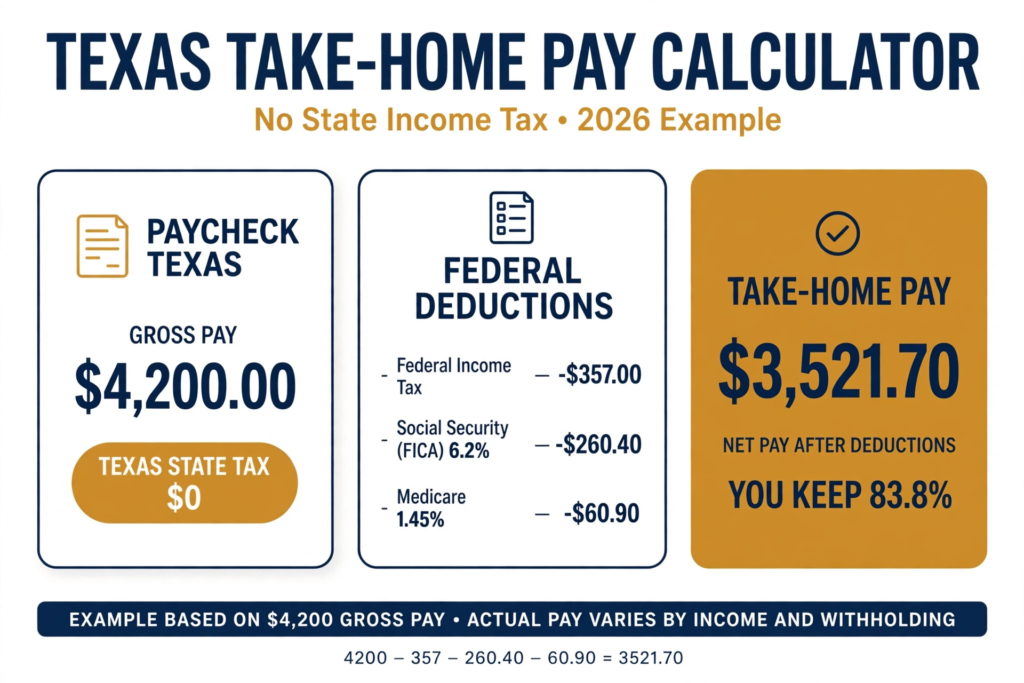
Texas Take-Home Pay by Salary (2026)
This table shows what workers at different salaries keep after federal income tax and standard employee FICA. It assumes a single filer, the $16,100 standard deduction, no credits or extra deductions, and 26 biweekly paychecks a year.
| Annual Gross Salary | Estimated Annual Take-Home | Average Biweekly Paycheck | Combined Effective Tax Rate |
|---|---|---|---|
| $40,000 | $34,320.00 | $1,320.00 | 14.20% |
| $50,000 | $42,355.00 | $1,629.04 | 15.29% |
| $60,000 | $50,390.00 | $1,938.08 | 16.02% |
| $75,000 | $61,592.50 | $2,368.94 | 17.88% |
| $100,000 | $79,180.00 | $3,045.38 | 20.82% |
| $120,000 | $93,250.00 | $3,586.54 | 22.29% |
| $150,000 | $113,791.00 | $4,376.58 | 24.14% |
These figures divide estimated annual tax by 26 pay periods. They aren’t guaranteed payroll deposits.
What the Salary Estimates Mean
A $40,000 salary leaves about $34,320 a year. At $75,000 the figure rises to $61,592.50, and at $100,000 it reaches roughly $79,180.
The effective rate climbs with income because more dollars land in higher brackets. Each bracket’s rate still applies only to the slice of income inside it.
Comparing salary offers? The Texas Salary Calculator gives a focused per-paycheck estimate for any annual salary.
Pay frequency changes the size of each check, not the yearly total. Here’s the $75,000 example split four ways:
| Pay Frequency | Paychecks Per Year | Approximate Take-Home Per Check |
|---|---|---|
| Weekly | 52 | $1,184.47 |
| Biweekly | 26 | $2,368.94 |
| Semimonthly | 24 | $2,566.35 |
| Monthly | 12 | $5,132.71 |
Treat all of these as guides, not payroll records.
Worked Example: $75,000 Salary in Texas
Here’s how a $75,000 salary breaks down in 2026 for a single filer who takes the standard deduction, earns regular wages, and has no other deductions or credits.
1. Gross Annual Salary
- Gross annual salary: $75,000
- Federal standard deduction: $16,100
- Federal taxable income: $58,900
2. Federal Income Tax
The first $12,400 of taxable income is taxed at 10%. The next $38,000 is taxed at 12%, and the last $8,500 at 22%.
| Tax Calculation | Amount |
|---|---|
| 10% of $12,400 | $1,240.00 |
| 12% of $38,000 | $4,560.00 |
| 22% of $8,500 | $1,870.00 |
| Total federal income tax | $7,670.00 |
3. Social Security Tax
Social Security is 6.2% of the full $75,000, since the salary sits well under the wage base.
$75,000 × 6.2% = $4,650.00
4. Medicare Tax
Medicare is 1.45% of the salary.
$75,000 × 1.45% = $1,087.50
Employee FICA taxes total $5,737.50.
5. Texas State Income Tax
Texas individual income tax on wages: $0.
6. Final Take-Home Pay
| Item | Annual Amount |
|---|---|
| Gross salary | $75,000.00 |
| Federal income tax | −$7,670.00 |
| Social Security tax | −$4,650.00 |
| Medicare tax | −$1,087.50 |
| Texas state income tax | $0.00 |
| Estimated annual take-home pay | $61,592.50 |
That works out to about $5,132.71 a month, or $2,368.94 per biweekly paycheck. Insurance premiums, retirement contributions, and other deductions would bring each check lower.
Texas vs. California: Same Salary, Different Take-Home
Texas doesn’t tax wages at the state level. California does, and it also charges a state disability insurance (SDI) payroll tax of 1.3% on all wages in 2026, with no cap.
The comparison below uses the same federal assumptions and adds California income tax and SDI. The figures are approximate and rounded.
| Annual Salary | Estimated Texas Take-Home | Estimated California Take-Home | Approximate Difference |
|---|---|---|---|
| $75,000 | About $61,600 | About $58,000 | About $3,600 |
| $100,000 | About $79,200 | About $73,000 | About $6,200 |
| $150,000 | About $113,800 | About $102,300 | About $11,500 |
California estimates assume a single filer with the state standard deduction and personal exemption credit. They exclude benefits and other deductions. Confirm the current California figures with the Franchise Tax Board.
Two people with the same salary can take home very different amounts depending on where they live. Housing, commuting, and insurance costs also decide how far a paycheck stretches, so the full comparison goes beyond income tax.
Why Texas Take-Home Pay Stretches Further
The lack of a state income tax draws many workers to Texas. A fair comparison also looks at the other taxes and costs that come with living here.
The $0 State Income Tax Advantage
Workers who live and work in Texas don’t see state income tax on their pay stubs. That simplifies the math and can mean real savings next to states that tax wages. The size of the benefit depends on income, filing status, and the state used for comparison.
Property Taxes Can Be Significant
Texas has no state-level property tax, but local governments levy their own to fund schools, roads, and emergency services.
As an illustration, a rate between 1.6% and 2.3% on a $300,000 home comes to $4,800 to $6,900 a year before exemptions. Actual bills vary by property, location, and exemptions, so check the local county appraisal district or the Texas Comptroller for current rates.
Sales Tax Adds to Everyday Spending
The state sales tax is 6.25%. Local governments can add up to 2%, which brings the combined rate to as much as 8.25%. Sales tax isn’t taken from a paycheck, but it adds up in daily spending.
Location Still Matters
Living costs differ across cities and regions. Houston, Austin, San Antonio, Dallas, and Fort Worth each come with their own housing prices, commute costs, insurance premiums, and local tax bills.
The state also includes Gulf Coast communities, farm country in East Texas, and stretches of the Great Plains. With such a large area and so many local economies, no single estimate fits every household. A calculator works best alongside a budget built for your own city.
What This Estimate Leaves Out
A salary calculator is a strong starting point, but it can’t predict the exact deposit. A few things can move the number.
W-4 Withholding Settings
Form W-4 tells an employer how much federal income tax to withhold. Filing status, adjustments, and extra withholding all change the amount taken from each check. Withholding is a prepayment, so it may not match the final tax owed at filing time.
Pre-Tax Deductions and Benefits
Health insurance premiums, retirement contributions, and other benefits lower take-home pay. Some of them also reduce the income used to calculate certain taxes, depending on the plan. This calculator leaves all of them out.
To run the numbers with your actual benefits and deductions included, try the Texas Net Pay Calculator.
Bonuses and Overtime
Bonuses, overtime, and commissions can swing a paycheck up or down. Employers often withhold federal tax on bonuses at a flat supplemental rate, and the final bill is settled at filing time. Federal law now also offers a limited deduction for qualified overtime pay, claimed on the tax return, not in each paycheck. Check current IRS guidance for the rules and limits.
Workers with variable pay should treat a salary-based estimate as a guide, not a forecast for every pay period.
Filing Status and Tax Credits
Single filers, married couples filing jointly, and heads of household use different brackets and deductions. Credits can lower federal tax further. A truly personal estimate needs more than a salary and a state.
Marginal vs. Effective Tax Rate
The marginal tax rate is the rate on your next dollar of taxable income. The effective tax rate is the share of income that actually goes to tax under a given calculation.
For a single worker earning $75,000, federal income tax is $7,670 and employee FICA is $5,737.50. Together that’s $13,407.50, or about 17.88% of gross pay. That’s the combined effective rate used in the salary table. Federal income tax alone works out to about 10.2%.
Neither number is the marginal rate, which for this worker is 22%. Knowing the difference keeps people from assuming their top bracket applies to every dollar they earn.
FAQs About Texas Take-Home Pay
What is take-home pay?
Take-home pay is what remains after taxes and payroll deductions, also called net pay. Gross pay is the amount earned before those deductions.
Does Texas have a state income tax?
No. Texas doesn’t tax individual wages at the state level. Workers still pay federal income tax and employee FICA.
How much take-home pay does a $75,000 salary provide in Texas?
A single filer earning $75,000 takes home an estimated $61,592.50 a year under the assumptions in this article, before benefits and other deductions.
How much take-home pay does a $100,000 salary provide in Texas?
Roughly $79,180 a year, or about $6,598.33 a month. That assumes a single filer using the 2026 standard deduction, with no extra deductions or credits.
What is FICA, and how much do employees pay?
FICA is the federal payroll tax that funds Social Security and Medicare. Employees pay 6.2% for Social Security on wages up to $184,500 and 1.45% for Medicare on all wages, for a combined 7.65% for most workers. Earners above $200,000 owe an extra 0.9% Medicare tax on the excess.
Does pay frequency change the total tax owed?
No. A $75,000 salary leaves about $61,592 a year whether it’s paid weekly, biweekly, semimonthly, or monthly. Only the size of each check changes.
How can employees increase take-home pay?
Start by checking the W-4 for accuracy, since over-withholding shrinks every paycheck. Then review benefit costs and consider tax-advantaged retirement contributions, which can lower taxable income. Any change should fit the worker’s real financial and tax situation.
Are property taxes included in this estimate?
No. Property taxes aren’t payroll deductions. Owners pay them directly, and renters often feel them through rent, so the take-home figures here leave them out.
Is the calculator accurate for every Texas employee?
It’s a close estimate, not a guarantee. Filing status, other income, credits, benefits, retirement contributions, and withholding choices can all change the result. The closer a worker’s situation matches the stated assumptions, the more useful the number.
Why is take-home pay lower than the salary shown on a job offer?
An offer usually states gross pay. Take-home pay comes after taxes, benefits, retirement contributions, and other deductions. Comparing net pay shows what’s really available for everyday expenses.
Final Thoughts
A Texas Take-Home Pay Calculator (2026) turns an annual salary into a practical estimate of net income. With no state income tax, the Texas side of the math is simple, but federal income tax and FICA still take a real share.
For a $75,000 salary, the estimate is $61,592.50 a year, and the salary table covers incomes from $40,000 to $150,000. Use those numbers as a starting point, then adjust for filing status, benefits, withholding settings, and where in Texas you live. Those details decide what actually reaches your account.
For the full paycheck breakdown with W-4 settings and deductions, use the main texas paycheck calculator.
Sources
- Internal Revenue Service: 2026 tax inflation adjustments (Revenue Procedure 2025-32) — irs.gov
- Social Security Administration: 2026 Social Security changes, including the $184,500 wage base — ssa.gov
- Texas Comptroller of Public Accounts: sales and property tax information — comptroller.texas.gov
- California Employment Development Department: 2026 State Disability Insurance rate (1.3%) — edd.ca.gov