A salary offer is just a starting number. This Texas salary calculator converts any annual salary into the per-paycheck take-home pay you will actually receive — accounting for 2026 federal taxes, FICA, and your deductions. No Texas state income tax applies, so what you see is driven purely by federal rules.
Back to the main texas paycheck calculator for the full paycheck breakdown.
Texas Salary Calculator: Calculate Your Texas Salary Paycheck
Texas Salary Calculator
Enter a salary or hourly wage below to estimate the Texas take-home pay behind it. Texas has no state income tax, so only federal tax, Social Security, and Medicare are withheld.
| Gross pay | / paycheck · / year |
| Federal income tax | / paycheck · / year |
| Social Security (6.2%) | / paycheck · / year |
| Medicare (1.45%) | / paycheck · / year |
| Texas state income tax | $0.00 / paycheck · $0.00 / year |
| Take-home pay | / paycheck · / year |
Monthly take-home: · Effective tax rate: · Total tax: / year
Estimate only — based on 2026 IRS federal brackets, the 2026 standard deduction, FICA rules, and the 2026 child tax credit ($2,200/child). Actual employer withholding may differ.
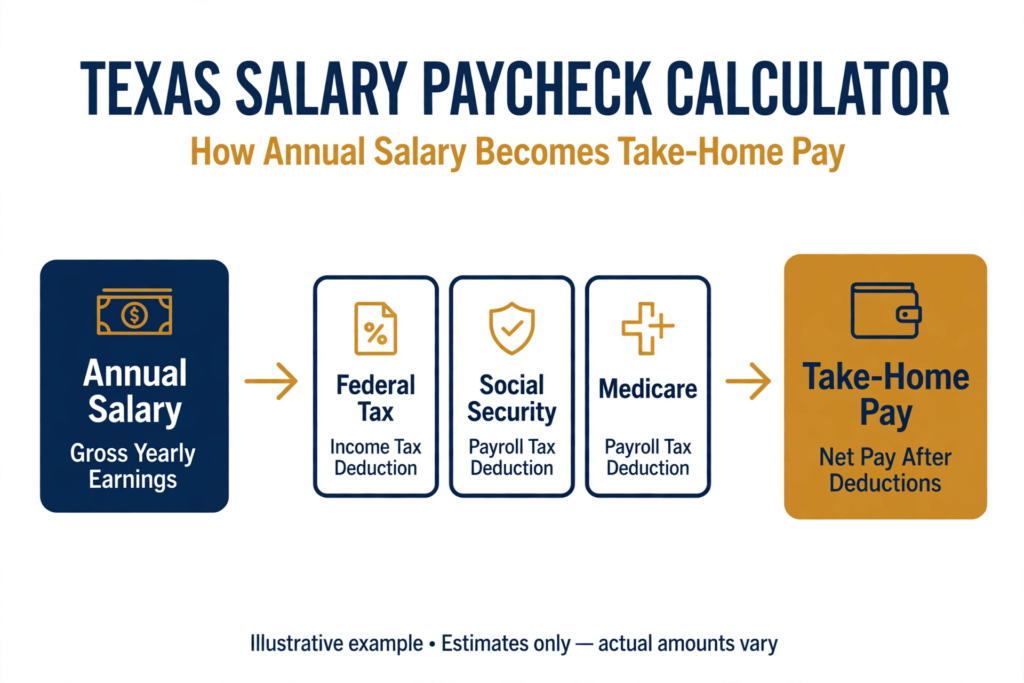
From Annual Salary to Paycheck
Employers quote salaries per year, but you live per paycheck. The conversion is simple division: annual salary divided by the number of pay periods. A $75,000 salary paid biweekly is $2,884.62 per check before anything comes out. What matters more is the after-tax figure, which is where this calculator earns its keep.
Salary vs. Hourly: Converting Both Ways
To turn an hourly wage into an annual salary, multiply the rate by weekly hours and then by 52. At $30 an hour and 40 hours a week, that is $62,400 a year. To go the other direction, divide the salary by 2,080 (40 hours × 52 weeks): a $75,000 salary equals about $36.06 an hour. Use the hourly mode in the calculator above if your offer is quoted per hour.
Worked Example: $75,000 Salary in Texas
A single filer on $75,000, paid biweekly, with no deductions:
- Gross per paycheck: $2,884.62
- Federal income tax: about $295.00 per paycheck
- Social Security + Medicare: about $220.68 per paycheck
- Texas state income tax: $0
Take-home: about $2,368.94 per paycheck — roughly $61,590 a year, or $5,130 a month. Compare offers on this after-tax number, not the headline salary.
What Shrinks a Texas Salary
Four things stand between a salary figure and spendable money: federal income tax (2026 brackets from 10% to 37%, applied marginally), Social Security at 6.2% up to $184,500, Medicare at 1.45% on all wages, and your own deductions. Pre-tax items like a traditional 401(k) reduce taxable income; post-tax items like Roth contributions do not.
To run the numbers with your actual deductions included, use the Texas Net Pay Calculator.
Using This Calculator for Job Offers
- Enter the offered salary and your filing status.
- Add the deductions the new job’s benefits would create (health premiums, 401(k) match target).
- Compare the take-home figure against your current job’s take-home — not the two headline salaries.
- If relocating from a state with income tax, the same salary can mean noticeably more take-home in Texas.
Conclusion
A salary only becomes real when you know the take-home number behind it. Punch in any offer above and see what a Texas paycheck from that salary truly looks like.
For the plain-English breakdown, try the Texas Take-Home Pay Calculator.
Frequently Asked Questions
How do I calculate my salary per paycheck in Texas?
Divide the annual salary by the number of pay periods: 52 for weekly, 26 for biweekly, 24 for semimonthly, 12 for monthly. Then subtract estimated federal taxes and deductions to get take-home per check. The calculator above does both steps.
What is a good salary in Texas in 2026?
It depends on the city and household size, but Texas median household income has recently sat in the mid-$70,000s. A $75,000 salary leaves roughly $61,590 a year after federal taxes for a single filer with no deductions.
How do I convert an hourly wage to an annual salary?
Multiply the hourly rate by hours worked per week, then by 52. For example, $30/hour × 40 hours × 52 weeks = $62,400 per year before taxes.
Does Texas tax my salary at the state level?
No. Texas has no personal income tax, so no state tax is withheld from your salary. Only federal income tax, Social Security, and Medicare reduce it.
Should I compare job offers by salary or take-home pay?
By take-home pay. Two identical salaries can produce different take-home figures depending on benefits costs, 401(k) contributions, and filing status. Always compare the after-tax number.
I work remotely from Texas for an out-of-state company. Which taxes apply?
Your Texas paycheck has no state income tax withholding. Some states try to tax remote workers, so check the employer’s state rules — but Texas itself takes nothing.
What deductions come out of a Texas salary?
Federal income tax, Social Security (6.2%), Medicare (1.45%), plus whatever you elect: health/dental/vision premiums, 401(k) or HSA contributions, and any post-tax items like Roth 401(k) or garnishments.